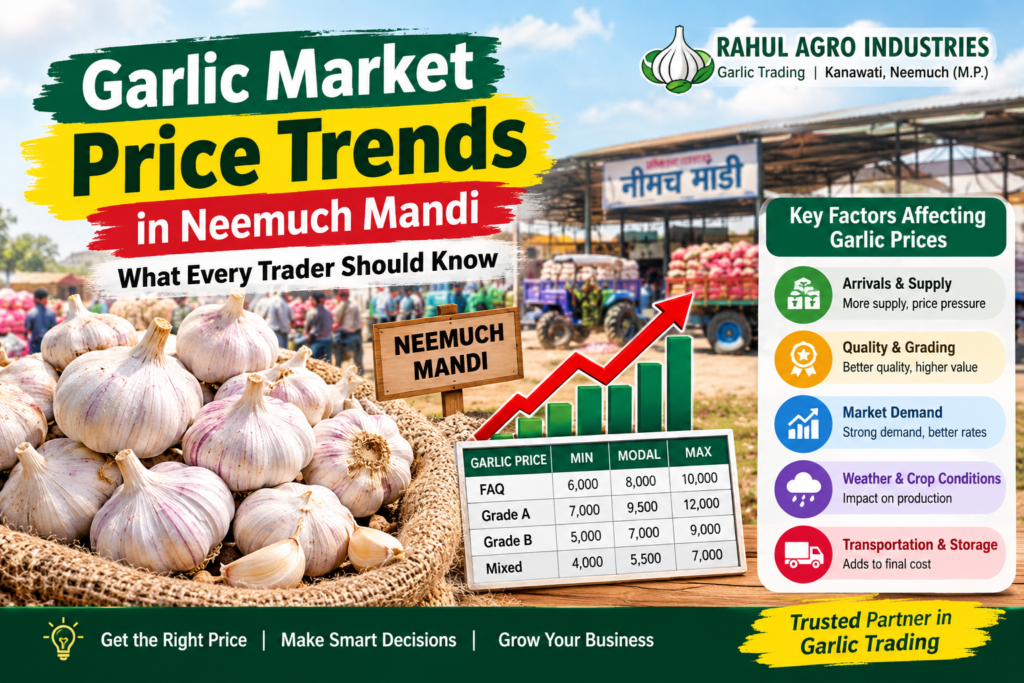
Garlic Market Price Trends in Neemuch Mandi: What Every Trader Should Know
Introduction
Garlic is an important agricultural commodity in India, and its market price plays a major role in the business decisions of farmers, wholesalers, stockists, retailers, and garlic traders. Neemuch Mandi, located in Madhya Pradesh, is an important market for agricultural trading. Understanding garlic market price trends in Neemuch can help traders evaluate purchasing opportunities, manage stock, and make informed business decisions.
At Rahul Agro Industries, Kanawati, Neemuch, Madhya Pradesh, we understand the importance of garlic quality, market information, and strong business relationships. In this blog, we explain the major factors affecting garlic prices and the practical points every trader should consider.
1. Understanding Garlic Prices in Neemuch Mandi
Garlic prices in Neemuch Mandi may change from one trading day to another. The rate depends on product quality, bulb size, variety, market arrivals, buyer demand, and the quantity offered for sale.
For example, an online Neemuch mandi report dated 23 October 2026 listed a modal price of approximately ₹8,000 per quintal for one FAQ garlic category. Other reported grades showed different rates. This demonstrates why traders should check the specific variety and quality instead of relying on a single market price.
These figures are historical reported examples, not a guaranteed buying or selling rate. Always verify the latest mandi information before making a deal.
2. Main Factors Affecting Garlic Market Prices
Garlic arrivals and supply
The quantity of garlic arriving at the mandi can influence prices. When arrivals increase and buyer demand remains steady, prices may face pressure. When arrivals are limited and demand remains strong, prices may receive support.
Traders should monitor daily arrivals and compare them with recent trading sessions to understand whether supply is increasing or decreasing.
Garlic quality and grading
Quality is one of the most important factors in garlic trading. Large, well-developed bulbs may attract different buyers from small, mixed-size, or damaged garlic.
Before finalising a purchase, examine bulb size, dryness, outer skin, cleanliness, and the percentage of damaged or defective bulbs. Compare prices only between lots of similar quality.
Market demand
Demand from wholesalers, retailers, food processors, and buyers in other regions can influence market prices. Strong demand may support rates, while weaker purchasing activity can put pressure on them.
Weather and crop conditions
Weather conditions during cultivation, harvesting, and drying can affect crop quality and marketable supply. Damage, moisture problems, or lower-than-expected production may influence market sentiment.
Storage and transportation costs
Storage, handling, loading, unloading, and transportation expenses affect the final cost of garlic. Traders should calculate these costs before deciding whether a purchase offers a reasonable business opportunity.
3. How to Read Garlic Price Trends
A single day’s price does not always show the complete market direction. Traders should study prices over several days and compare similar quality grades.
Consider these three situations:
- Rising prices: Rates increase over several trading sessions. Check whether stronger demand, lower arrivals, or improved quality premiums are supporting the movement.
- Falling prices: Rates decline over several sessions. Review arrivals, buyer participation, and the quality of available stock.
- Sideways market: Prices move within a relatively narrow range. Buyers and sellers may be waiting for clearer signals about supply and demand.
It is also useful to compare minimum, modal, and maximum prices. The modal price represents the most frequently occurring reported price for a trading session, while the minimum and maximum show the reported range.
Large differences between these figures may indicate substantial variation in quality or lot characteristics.
4. Practical Buying Strategies for Garlic Traders
Successful garlic trading requires planning rather than relying only on market predictions.
First, identify the quality and quantity your customers need. Next, compare available lots and calculate the complete landed cost, including transportation and handling.
Second, avoid purchasing large quantities solely because prices have risen recently. A rising market does not guarantee further increases.
Third, consider dividing purchases into smaller lots when appropriate for your business, storage capacity, and cash flow. This can reduce the risk of committing all your capital at one market rate.
Finally, maintain regular communication with buyers and suppliers. Confirm quality, quantity, payment terms, and delivery arrangements before finalising transactions.
5. Should Traders Store Garlic or Sell Immediately?
The decision to store garlic depends on its condition, storage facilities, working capital, expected expenses, and market outlook.
Storage may provide an opportunity to sell later, but it also introduces risks. Garlic can lose weight or quality, deteriorate, or incur additional handling and storage costs.
Before storing garlic, estimate the total cost per quintal, including expected losses and financing expenses. Compare that amount with realistic future selling scenarios.
Never assume that garlic prices must rise simply because stock is being stored. Market conditions can change unexpectedly, and capital may remain tied up for an extended period.
6. How to Follow Daily Neemuch Garlic Mandi Rates
For better trading decisions, follow a consistent daily routine:
- Check the latest available garlic prices from reliable mandi reporting sources.
- Record the date, variety, minimum rate, modal rate, and maximum rate.
- Compare the latest report with prices from previous trading sessions.
- Monitor market arrivals and buying interest.
- Check the quality of the actual lot before accepting a quoted rate.
- Calculate transportation, storage, and other business expenses.
- Update your buying and selling decisions using verified information.
Remember that online market data can sometimes be delayed, incomplete, or inconsistent. Confirm important rates with the relevant mandi or trusted market contacts before completing a transaction.
7. Why Choose Rahul Agro Industries for Garlic Trading?
Rahul Agro Industries is located in Kanawati, Neemuch, Madhya Pradesh, and is engaged in garlic trading.
We believe that successful agricultural trading depends on product quality, clear communication, reliable business practices, and long-term relationships.
Our aim is to connect with garlic wholesalers, retailers, bulk buyers, and fellow traders who value professional communication and quality-focused trading.
Buyers can contact Rahul Agro Industries to enquire about garlic availability, product quality, current trading information, and their specific quantity requirements.
We encourage every buyer to verify the quality, quantity, price, and terms of a transaction before confirming an order.
Conclusion
Garlic market price trends in Neemuch Mandi are influenced by arrivals, quality, demand, weather, storage, and transportation expenses. Traders who monitor daily prices, compare similar grades, and calculate their complete costs can make better-informed business decisions.
There is no guaranteed formula for predicting garlic prices. A disciplined approach, reliable market information, and careful purchasing decisions are essential for sustainable trading.
Rahul Agro Industries, Kanawati, Neemuch, Madhya Pradesh, welcomes enquiries from garlic buyers, wholesalers, and fellow traders.
For garlic availability, quality details, and current market information, contact Rahul Agro Industries and discuss your business requirements.
Rahul Agro Industries — Your Trusted Partner in Garlic Trading.